Benefits of Parallel Capacitors
Technical Support
In power systems, capacitor banks or parallel capacitors can supply leading reactive power to counteract the lagging reactive power generated by loads (such as motors), thereby improving the power factor of the load. The fundamental benefits of parallel capacitors include reducing the current in the main circuit, improving the voltage at the load side, reducing line losses, and increasing the power supply capacity of the system.
Example 1
For a load consisting of two 100 kW motors with a power factor of cosθ = 0.74, if no parallel capacitors are installed, the power supply capacity required would be calculated as follows:kVA=cosθkW=0.74200 kW≈270 kVA.At the same time, the lagging reactive power generated by the motors would be:kVAR=kW×tanθ=200 kW×0.9≈180 kVAR.

Example 2
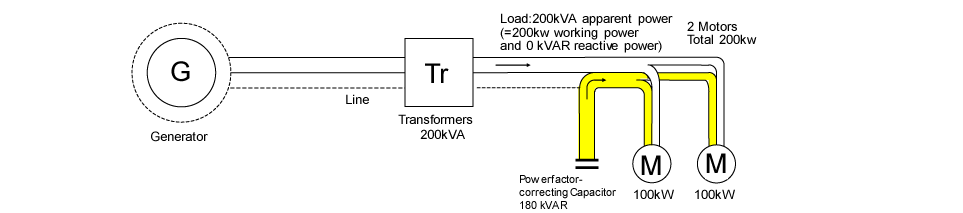
For the same load of two 100 kW motors, if a 180 kVAR parallel capacitor is installed, the power supply capacity will be reduced to 200 kVA. In this case, the reactive power generated by the motors will be completely absorbed by the capacitor, resulting in a reactive power of zero.

Example 3
Assuming the power supply capacity remains unchanged at 270 kVA, if a 240 kVAR parallel capacitor is installed, the load can be increased to three motors totaling 270 kW.
Note
To simplify the examples, power losses in transformers and supply lines are not included in these calculations.